

The passive safety and simplicity of a true school wing, built on an architecture advanced enough to take you well beyond your training: all the way to your first thermals, your first cross-country kilometres and your first SIV course.
 Pierre-YvesDesigner · AEROTECH, Vence
Your first wing is probably the most important choice of your progression. It is the wing that will be with you for your first inflations, your first big flights, your first thermals, your first cross-country kilometres and, why not, your first SIV course.
“The A1 is the wing that best represents my vision of a beginner paraglider. After more than twenty years devoted to paraglider design, to teaching, and today to inspecting, repairing and servicing hundreds of wings in our workshop, I wanted to create my ideal school wing: reassuring enough to accompany a student from their very first day of training, and progressive enough to keep teaching them something several hundred flights later.”
Like all AEROTECH products, it is developed according to the Premium Access™ philosophy: product quality comes first, with the best value for money thanks to a completely rethought business model.
The A1 is built on a particularly ambitious platform for an EN A wing: solutions usually reserved for “A+” category wings, deliberately toned down to remain reassuring.
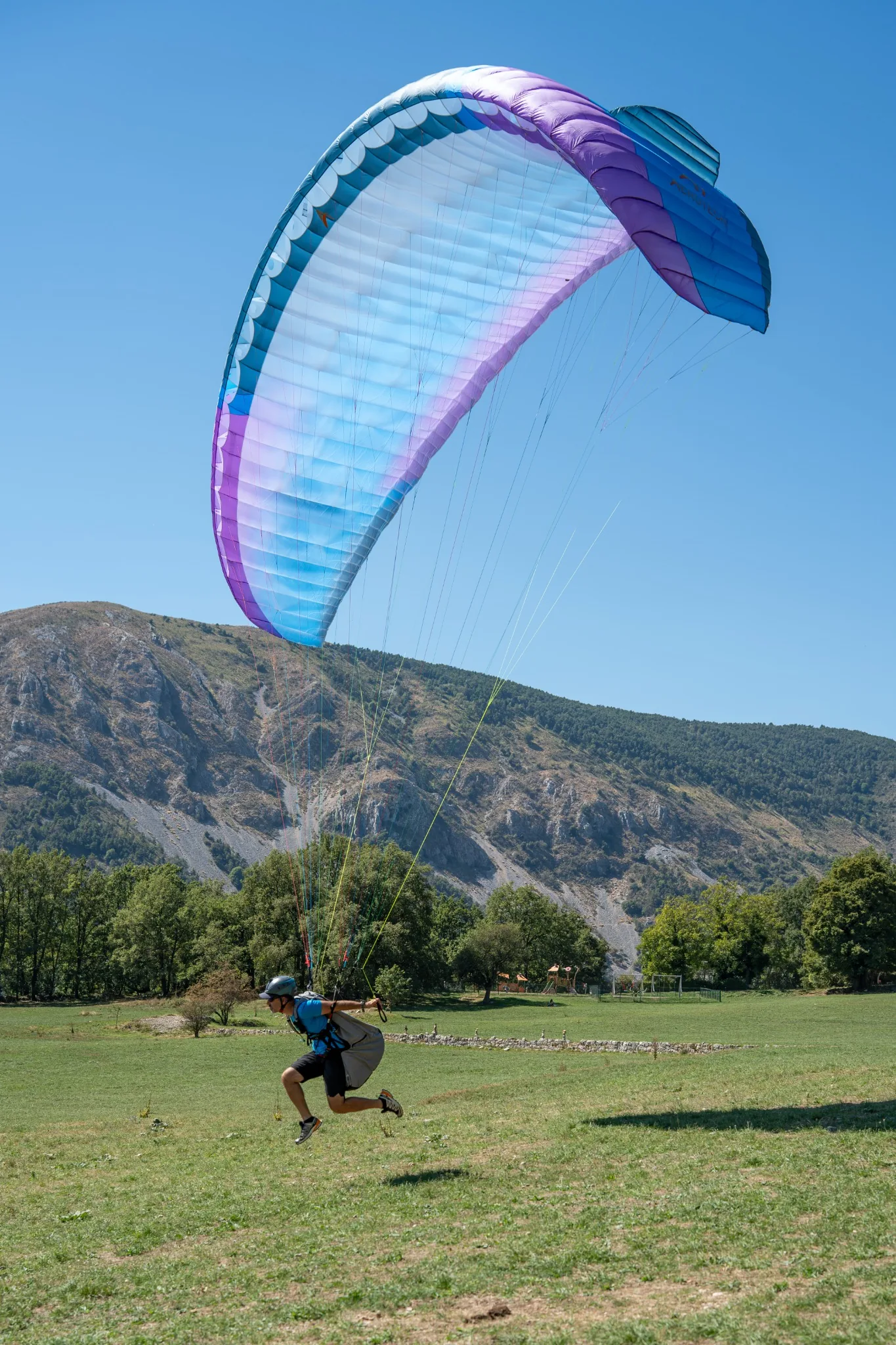
Progressive inflation, natural lift-off, consistent behaviour across the whole certified weight range. The brakes offer plenty of travel to forgive mistakes, while keeping the precision needed to learn active piloting and thermal centring.
The A1 is made by our partner in Thailand, a factory that has been building paragliders for more than 20 years and whose priority is to keep improving the quality of its inspection and assembly processes. We are very proud to work with them.
The A1 uses a highly developed architecture, with a 42-cell platform, more than usual on a school wing: the aim was to make it a capable, progressive wing rather than a basic one.
The winglets naturally damp roll and yaw: a wing that is easy to recentre in thermals and very tolerant of mistakes.
Very wide weight ranges that cover practically all pilots, with little stock needed for schools, and very consistent behaviour wherever you sit in the weight range.
The A1 was first developed to meet the needs of our own school. Every detail makes life easier for instructors and students alike, because a good school wing must also make everyday teaching easier.
Combined with very simplified lines, for easier handling and untangling.
A good grip, reassuring for students.
A dedicated riser lets you pull big ears quickly, with no hesitation about which line to grab.
The colour layout was worked out so that, in all circumstances, the instructor can tell whether the student is coming towards them or moving away, by clearly identifying the centre of the wing and the wingtips, in either direction.
Durability guided every one of our technical choices. Our goal is simple: for a wing to keep its behaviour, its handling pleasure and its passive safety qualities for as long as possible.
The most stressed areas use Porcher fabrics exclusively, renowned for their dimensional stability and resistance to ageing. Less stressed areas receive a carefully selected MJ-Tex: optimised weight and cost, uncompromised reliability.
Lower lines in Edelrid aramid, upper cascades mainly in Liros Dyneema. We chose quality suppliers and optimised the diameters and the placement of the materials so that the lines work as little as possible: very little change in length, few adjustments and as little maintenance as possible.
Our aim: for the wing and its lines to age together. All too often, lines sized too tightly have to be replaced during the wing's life, with the costs that implies. For us, well-designed lines keep pace with the wear of the other materials: that is the spirit in which the A1's lines were designed, to stay with it throughout its life.
A single Nitinol rod combined with a specific Dacron reinforcement: the profile geometry is preserved over time, without the friction points of multi-rod designs.
The risers are designed to accept rear riser control handles, supplied in the accessory kit. Deliberately not fitted as standard, you install them the day you want to discover rear riser piloting.
| STOW 55 – 90 kg | MTOW 70 – 110 kg | LTOW 90 – 125 kg | |
|---|---|---|---|
| EN/LTF A certified take-off weight range kg | 55 – 90 | 70 – 110 | 90 – 125 |
| Glider weight kg | 4.5 | 5.0 | 5.5 |
| Number of cells | 42 | 42 | 42 |
| Flat area m² | 23.6 | 26.5 | 29.3 |
| Projected area m² | 19.99 | 22.45 | 24.82 |
| Flat span m | 10.70 | 11.34 | 11.92 |
| Projected span m | 8.39 | 8.89 | 9.35 |
| Flat aspect ratio | 4.85 | 4.85 | 4.85 |
| Projected aspect ratio | 3.52 | 3.52 | 3.52 |
| Chord m | 2.71 | 2.88 | 3.03 |
| Risers | 3+1 | 3+1 | 3+1 |
| Speed system mm | 140 | 140 | 165 |
| Brake travel cm | > 65 | > 70 | > 70 |
| Certification chest strap width cm | 40 – 44 | 40 – 48 | 44 – 48 |
| Certification EN 926-2 | EN/LTF A | EN/LTF A | EN/LTF A |
| Recommended use, beginners: training hill and first flights (TOW, kg) | 55 to 75 | 70 to 95 | 90 to 110 |
| Recommended use, students with more than 10 flights (TOW, kg) | 55 to 85 | 70 to 100 | 90 to 120 |
| Recommended use, students with more than 30 flights and independent pilots: the whole range (TOW, kg) | 55 to 90 | 70 to 110 | 90 to 125 |
Here is some guidance to help you understand how your take-off weight affects the behaviour of your A1.
Each A1 size covers its own take-off weight range (TOW: equipped pilot, wing, harness and reserve) covered by the EN/LTF A certification: S from 55 to 90 kg, M from 70 to 110 kg, L from 90 to 125 kg. These ranges were deliberately made very wide, and the load changes the character of the wing: less loaded (bottom of the range), it is calmer and more tolerant; more loaded (top of the range), it becomes more dynamic and faster. It remains a school wing.
Certified across the whole range. Whether you fly the A1 at the bottom or the top of the range, it remains fully certified and compliant with EN A and LTF A, the most demanding certification there is for a paraglider. Its design gives it very consistent passive safety behaviour across the whole weight range: the changes in behaviour described here remain moderate and limited, within an effective certification and with a high level of passive safety. Where you sit in the A1's weight range therefore depends on your goal, your expectations and your main flying site.
| TOW (kg) | 55 | 60 | 65 | 70 | 75 | 80 | 85 | 90 | 95 | 100 | 105 | 110 | 115 | 120125 | |
|---|---|---|---|---|---|---|---|---|---|---|---|---|---|---|---|
| S | Gentle zone | 55–75 | |||||||||||||
| Intermediate | 65–85 | ||||||||||||||
| Dynamic | 75–90 | ||||||||||||||
| M | Gentle zone | 70–95 | |||||||||||||
| Intermediate | 80–100 | ||||||||||||||
| Dynamic | 95–110 | ||||||||||||||
| L | Gentle zone | 90–110 | |||||||||||||
| Intermediate | 100–120 | ||||||||||||||
| Dynamic | 110–125 | ||||||||||||||
Each bar shows the range of one zone; weights are read on the lines between the cells (5 kg steps). The zones overlap: in the shared part, the two behaviours meet. E.g. on the S, gentle zone from 55 to 75 kg, intermediate zone from 65 to 85 kg, dynamic zone from 75 to 90 kg.
Gentle zone: the most tolerant, recommended from the very first flights Intermediate zone: livelier, recommended from 10 flights Dynamic zone: the most responsive, recommended from 30 flights
What to expect depending on where you sit in the range?
Ideal for beginners: less active piloting, and the long brake travel is more forgiving of mistakes.
This is the loading the wing was designed for: the best balance between sink rate, turning pleasure, top speed and overall flying enjoyment.
More fun for the pilot who is refining their skills: better body positioning in turns, more precise brakes.
Good to know: if you choose to rent an A1, you can change size along the way. We recommend starting at the bottom of the weight range, then moving to the smaller size once your level of expertise has increased.
Which zones are recommended for your level? Here are the recommended zones according to the level of expertise you will have reached as you progress. This is not restrictive: nothing prevents you, even with a high level of expertise, from flying at the bottom of the A1's weight range so that its flight characteristics match your needs. If you fly in flatland and must above all favour sink rate to make the most of weak thermals, a position at the bottom of the range may be more worthwhile. If on the contrary you fly on the coast, often in strong wind, you will be better off aiming for the top of the range.
At first, it is your level of expertise that limits where you sit in the weight range; once that expertise is acquired, it is your flying environment and your needs that determine which A1 suits you best. If in doubt, do not hesitate to contact us.
| Your level | Gentle zone | Intermediate zone | Dynamic zone |
|---|---|---|---|
| Beginner: training hill, first flights | ✓ | ||
| Student with more than 10 flights | ✓ | ✓ | |
| Student with more than 30 flights, independent pilot | ✓ | ✓ | ✓ |
Example: a pilot weighing 80 kg fully equipped. Under an M, they are in the gentle zone: it suits them from their very first flights. Under an S, they are between the intermediate zone and the dynamic zone: it will suit them rather from around thirty flights; as a beginner, we would recommend the M.
Data taken from the official A1 flight manual (V1.5, June 2026). Apart from the speed system, the wing is fitted with no adjustable, removable or variable device.
We chose three colourways with clearly distinct shades: a mainly lime green wing, a mainly blue one and one in orange tones. Three bold colourways that we strive to keep in stock at all times, in every size, so we can meet your needs as quickly as possible. Want to customise the colours of your A1? No problem: use the simulator below. Allow about 2 months for a custom colourway.
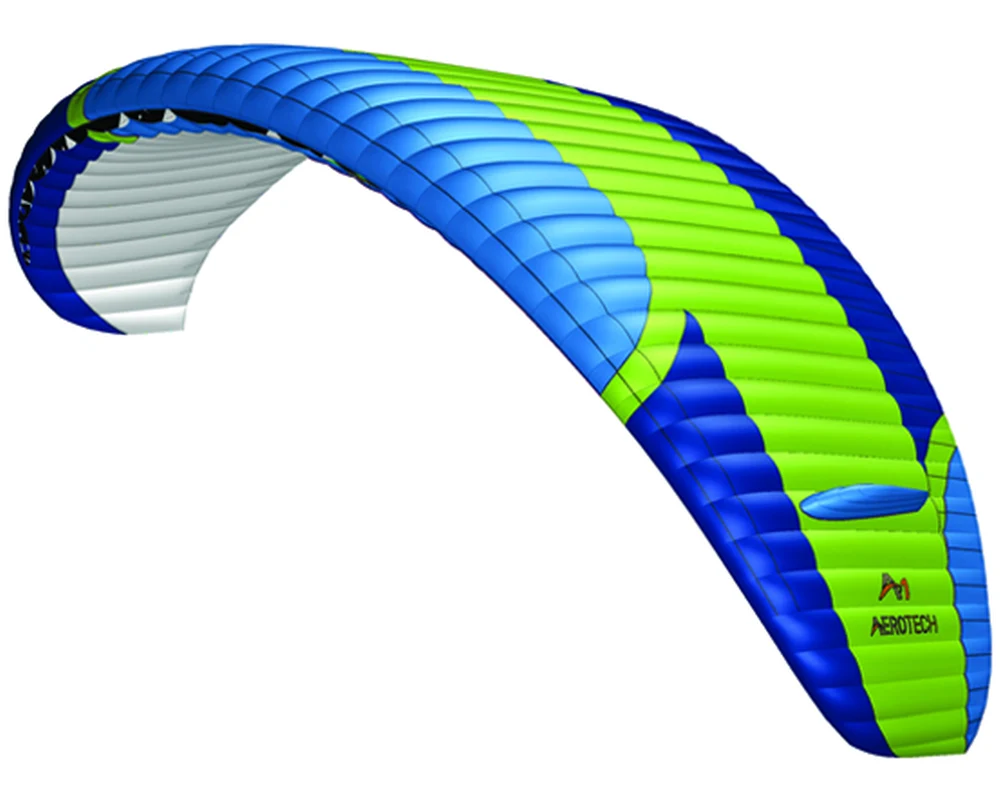
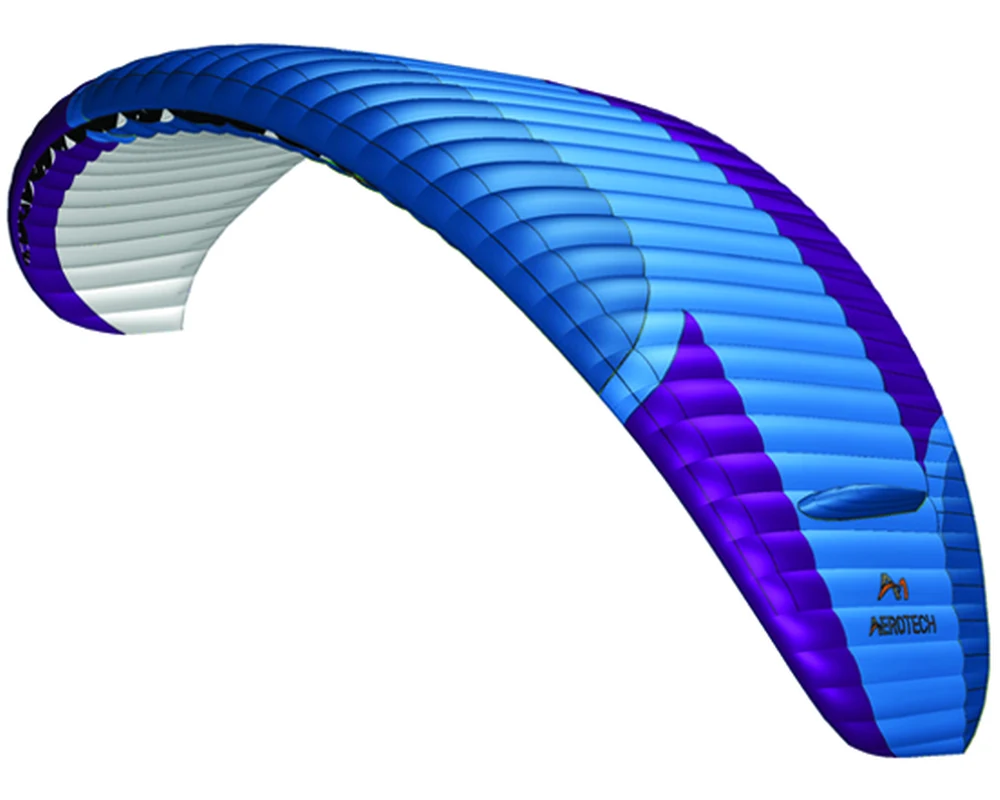
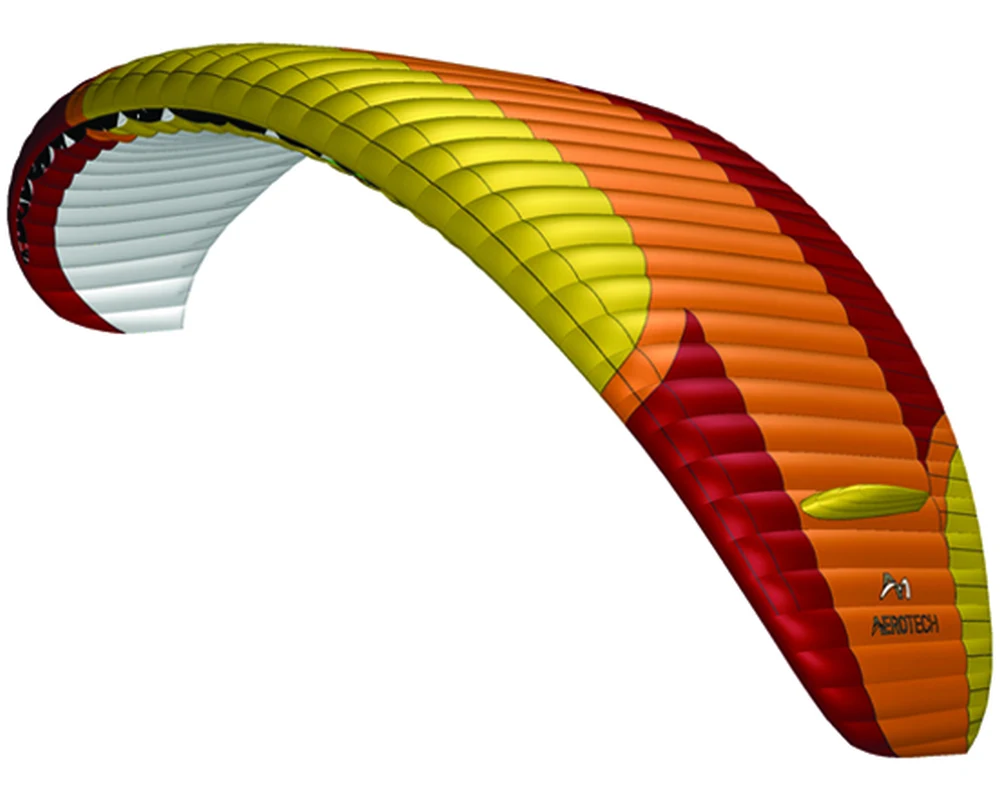
Three zones of the A1 can be customised with the colours available at the factory. We update this colour chart every week, but fabric stock can change faster than our updates, so we cannot guarantee 100% that a colour is available. Send us your design and we will quickly get back to you to confirm it.
Loading the render…
Loading the 3D wing…
Drag to rotate · zoom: right-click or press the wheel, + / −Zone 1 · Porcher Skytex 38 fabric
Leading edge in the centre of the wing, trailing-edge band towards the tips and raised panel above the logo.
Zone 2 · Porcher Skytex 38 fabric
Wide diagonal central band carrying the A1 AEROTECH logo.
Zone 3 · Porcher Skytex 38 fabric
Trailing edge in the centre of the wing and leading edge towards the tips.
Zone 4 · MJ-Tex 32 fabric ·White
Lower surface (underside of the wing): always white, cannot be changed.
Your logo
Add your logo in place of the Aerotech logos and see it in 3D. Preferably a PNG with a transparent background, or an SVG. The file stays on your computer: attach it to your request.
Size (total flying weight):
Request this designColours from the Porcher Sport fabric range, plus the Petrol Blue of the ICE colourway. You can also call the workshop on +33 6 20 89 91 31.
Indicative render based on the A1 3D visuals: actual fabric shades may vary slightly. The lower surface stays white, as on the standard colourways.
The A1 is available in two configurations.
Everything you need to fly, maintain and repair.
The Standard version, plus the AEROTECH 130-litre rucksack.
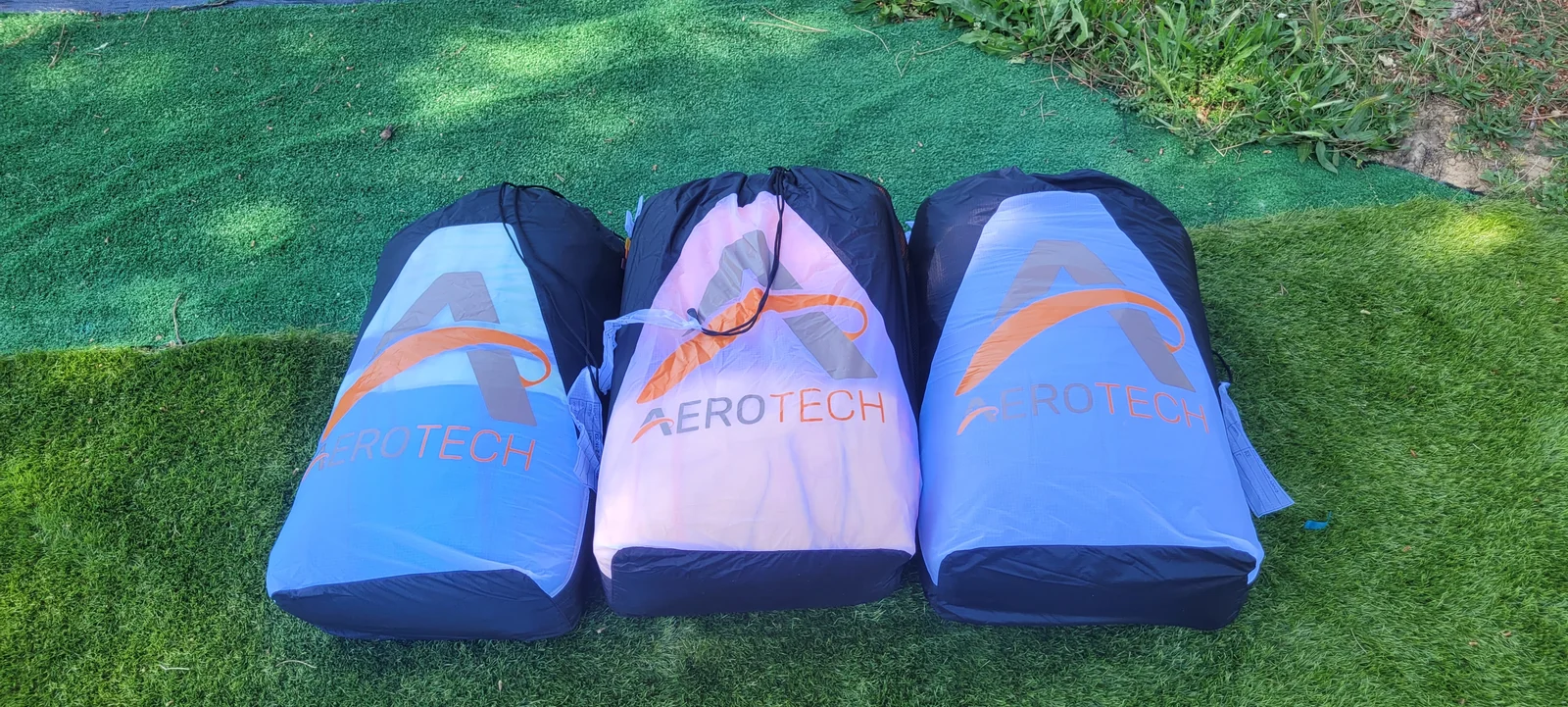
Premium Access™ is built on a simple idea: invest as much as possible in what genuinely improves the product (design, materials, manufacturing, durability) while removing the costs that bring no value to the pilot. The result: paragliders with no compromise on quality, at a price positioning unseen on the market.
Designed in Vence, inspected in our workshop. Tell us about your flying and your build: we will advise you on the right size and configuration.